344 LEADS AT $14.97 FROM META ADS
HOW WE REBUILT THE AD ACCOUNT AND THE CONTENT ENGINE FOR A MIAMI GENERAL CONTRACTOR
Client:
ZALI CONSTRUCTION
Services:
Meta Ads, Social Media & Content
Timeline:
May 15 to September 15, 2026
ZALI Construction installs wall and ceiling panels, interior and entry doors, decking and flooring in waterfront homes and penthouses across South Florida. Until May 2026 its advertising was a Boost button on somebody’s phone: no audiences, no tested offers, no creative strategy and no way to tell which dollar brought which customer. We rebuilt the account and the content behind it from scratch, and $5,150 of Meta ad spend returned 344 leads at $14.97 each.
Leads
344
Real conversations, not form fills
Cost per lead
$14.97
Blended across every format tested
Best format
$9.83
Per conversation, against $89.53 for a form
Organic views
416K
+108.6% on the content engine behind the ads
What We Inherited
A contractor whose finished work photographs beautifully and whose advertising showed none of it. The first week was spent on an audit rather than on launching anything, because every number below had to be fixed before a single dollar would behave predictably.
| Area | May 2026 |
|---|---|
| Ad account | Reels boosted straight from the phone, no campaign structure, no naming, no budget logic |
| Audiences | Broad Miami, no segmentation between homeowners and the trade |
| Offers | None. The ads said what the company does, never why anyone should answer today |
| Creative | Raw job site clips with no hook, no caption strategy and no first frame worth stopping for |
| Tracking | No pixel events worth optimizing on, so the algorithm was buying clicks and nothing else |
| Content | A profile with 5,900 followers, no visual system and no publishing rhythm |
The Process, From A to Z
Paid social fails most often because the launch comes first and the thinking comes afterwards. We ran it in the opposite order. Nothing went live until the research, the positioning and the creative system were finished, which is why the first campaign already had something to say.
| Stage | What we did | Why it comes here |
|---|---|---|
| 1. Audit | Account structure, past results, pixel events, profile, feed, bio and highlights | You cannot improve a number you have not measured, and most of these had never been looked at |
| 2. Competitor research | Every live ad from the strongest panel and door companies in the market, pulled from the Meta Ads Library | Their ads reveal which offers they keep paying to run, which is the closest thing to free market research |
| 3. Positioning and offers | Three audience segments, one price-led offer written for each | Creative cannot rescue a weak offer, so the offer is settled before anything is designed |
| 4. Content system | Brand book applied to the profile, content rubrics, a daily publishing plan | Ads send people to a profile. A thin profile kills the conversion the ad just paid for |
| 5. Creative production | Reels, carousels and statics built per segment, each with a hook, a price and a reason to reply | Creative is the only real targeting lever left on Meta |
| 6. Structured testing | Three rounds on entry format, run with real budget rather than opinion | The winning format was not the one the industry recommends, and only a test would have shown it |
| 7. Scale and rebuild | Two fresh ad accounts, new audiences, budget moved entirely into the winner | A ceiling in an old account is a signal to rebuild, not to spend harder |
| 8. Reporting | Cost per conversation, per segment, per creative, reviewed weekly | Reach and impressions do not pay a crew, so they were never the metric |
What the Competitors Taught Us
Before spending a dollar we went through every live ad from the strongest players in panels and doors in South Florida: Wallpanels.com, Panel Decor Hub and Dayoris Doors. The Meta Ads Library shows what a company is paying to keep running, and a campaign that stays live for months is a campaign that works. Three patterns repeated across all of them, and all three were opportunities.
| What they all did | What it costs them | What we did instead |
|---|---|---|
| Sent cold traffic to a crowded homepage | The visitor lands on a menu rather than an answer and leaves | Kept the conversation inside Instagram, where the person already is |
| Asked for five required fields before saying anything | Every extra field is a reason to close the tab | One opening message, answered by a human within minutes |
| Never named a price | The homeowner assumes the worst and keeps scrolling | Put a starting price in the creative itself |
| Sold single tasks: a door, a panel, a wall | Competes on unit price against every handyman in Miami | Sold the finished room as one package |
| Ignored designers and contractors entirely | Leaves the highest repeat-value audience unclaimed | Built a separate offer and separate creative for the trade |
The strategic read
An entire category was advertising the same way, which meant the cheapest differentiation available was not a better budget or a cleverer audience. It was simply naming a price and offering a conversation, and no competitor in the market was doing either.
Three Audiences, Three Different Conversations
A luxury homeowner and a general contractor are both buying wall panels, and almost nothing else about them is the same. One is buying how the room will feel when the guests arrive. The other is buying a supplier who will not wreck the schedule. Writing one ad for both means writing an ad that moves neither, so we split the account at the audience level and wrote the offer before the creative.
| Segment | Who they are | What actually moves them | The offer |
|---|---|---|---|
| Luxury homeowners | Homes from $1M in Coral Gables, Coconut Grove, Pinecrest and Miami Beach | Finish quality, exclusivity and the certainty that their home will not be a building site for a month. Never a discount | A transparent project estimate in 24 hours, plus a free 3D concept for an accent wall |
| The trade | Designers, architects and general contractors running several projects at once | Schedule, specification accuracy and one installer they can keep using. A single trade partner brings work for years | A dedicated manager, a warranty on hardware and a free measurement from six doors up |
| Commercial | Restaurants, offices and hotels | Acoustics, certifications, hidden doors and ceilings, and a crew that can work around opening hours | Prices named in the creative: panels from $10 per sq ft, decking from $9.87 |
Why the price went into the creative
Naming a starting price is usually treated as a risk, because it invites comparison. In a market where nobody named one, it did the opposite. It filtered out the people who were never going to spend $30,000 on a room before they cost us a click, and it signalled confidence to the people who were.
The Creative: Formats and What Each One Is For
On Meta the creative is the targeting. The algorithm will find whoever responds to what you show, so the job is to show something only the right person responds to. We built a format library rather than a pile of ads, where every format has one role and gets judged on that role alone.
| Format | The job it does | How it is built |
|---|---|---|
| Transformation Reel | Stops the scroll and proves the result in under three seconds | Opens on the finished room, cuts back to the bare wall, returns to the finish. The reveal goes first, never last |
| Process Reel | Builds trust with the homeowner who fears the mess more than the invoice | Shot on live job sites: dust control, clean cuts, protected floors, a crew that looks like it respects the house |
| Detail close-up | Carries the premium positioning that a wide shot cannot | Macro on the joint, the reveal line, the hardware. This is the frame that separates finish carpentry from a handyman |
| Price carousel | Qualifies the lead before they ever write in | Slide one names the starting price, the middle slides show the range of finishes, the last slide asks the question |
| Trade creative | Speaks to designers and contractors in their own language | Specs, lead times and a named manager instead of lifestyle imagery. Different copy, different offer, same production quality |
| Static with offer | Carries the single clearest message when video is not needed | One finished room, one line of copy, one call to action. Used to test offers quickly before committing to a video |
Three Rules Every Ad Had to Pass
- The first frame must be the finished result. Nobody stops for a bare wall, so the before shot comes second
- The price or the offer must be visible without sound. Most of the feed is watched muted, so anything spoken is effectively unsaid
- The call to action asks a question, never a favour. “Which room are you doing?” outperforms “Contact us” because it is easier to answer than to ignore
The Content Engine Behind the Ads
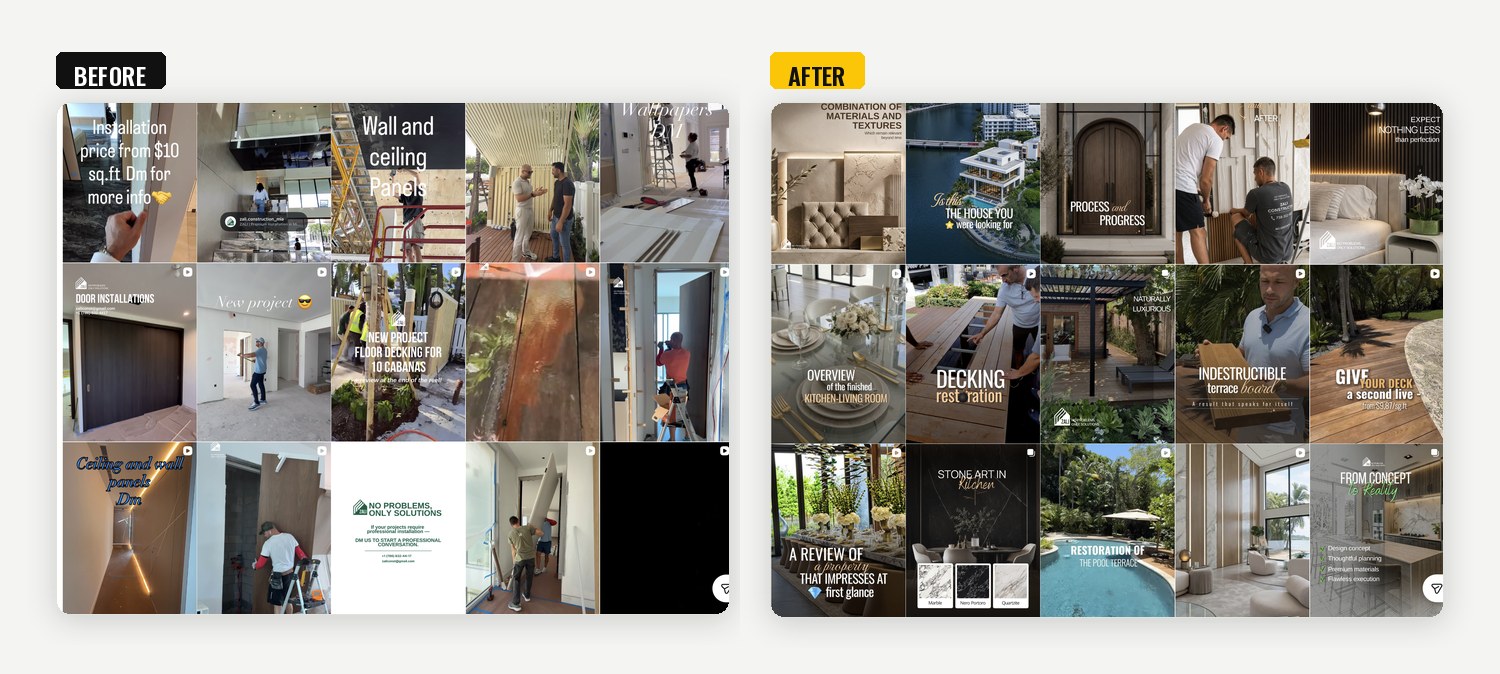
Every ad sends the viewer to the same place: the profile. If the profile is a scrapbook, the money spent on the ad is wasted at the last step, because a homeowner about to spend $50,000 reads the grid before they write a word. So the content was rebuilt as a condition of running the ads, not as a separate service.
What the Rebuild Involved
| Element | What we built |
|---|---|
| Visual system | The brand book applied to every post: palette, type, framing and a consistent grid rhythm, so the profile reads as one magazine rather than a camera roll |
| Content rubrics | Recurring formats the audience learns to expect: transformations, process, material explainers, finished project tours, answers to the questions that come up in every estimate |
| Publishing cadence | Reels, stories and posts every single day on the main account, with a content plan written a month ahead so nothing depends on whether the site was busy that week |
| Profile conversion | Bio, highlights and pinned posts rewritten so a cold visitor finds the price range, the service list and the way to ask within one screen |
| Ad and organic loop | The best performing organic Reels became paid creative, and the paid winners were re-cut for the feed |
What It Produced
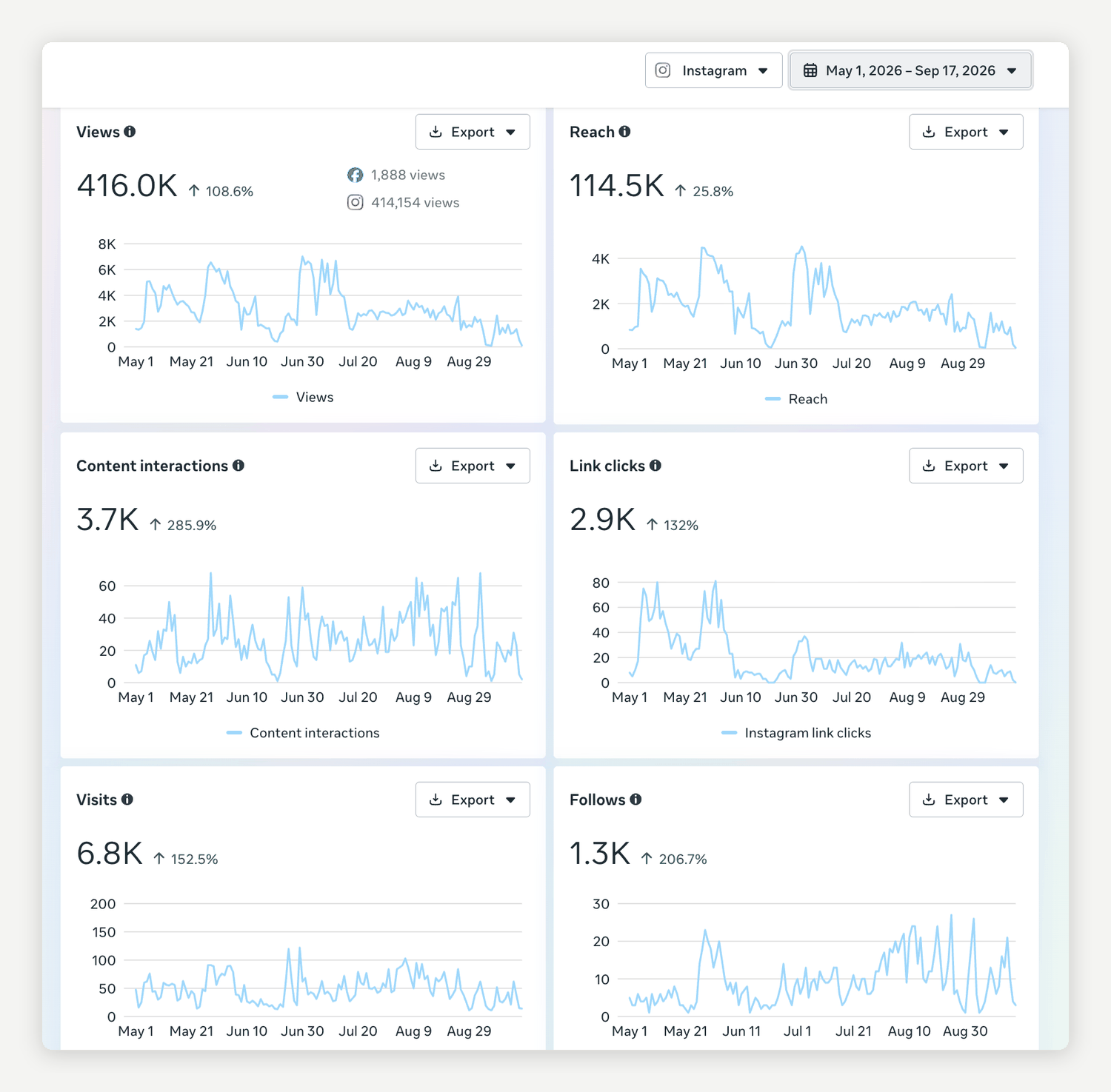
Paid promotion on the main account began on 22 June. The first seven weeks of this growth were earned organically, which is why the advertising later landed on an audience that was already warm rather than building one from nothing.
Views
416K
+108.6% on the previous period
Followers
5,900→7,199
+1,299 in four months
Content interactions
+285.9%
3.7K in the period
Profile visits
+152.5%
6.8K visits
| Main account, 1 May to 17 September 2026 | Result | Change |
|---|---|---|
| Views | 416,000 | +108.6% |
| Reach | 114,500 | +25.8% |
| Content interactions | 3,700 | +285.9% |
| Link clicks | 2,900 | +132% |
| Profile visits | 6,800 | +152.5% |
| Follows | 1,300 | +206.7% |
Over the last 90 days the main account collected 241,665 views and a net gain of 752 followers, and 83.4% of those views came from people who do not follow it. That number is the one that matters for a paid campaign, because it means the content is reaching strangers rather than entertaining the existing audience. Reels carried 38K of those views and stories another 23K.
The Test That Moved the Entire Budget
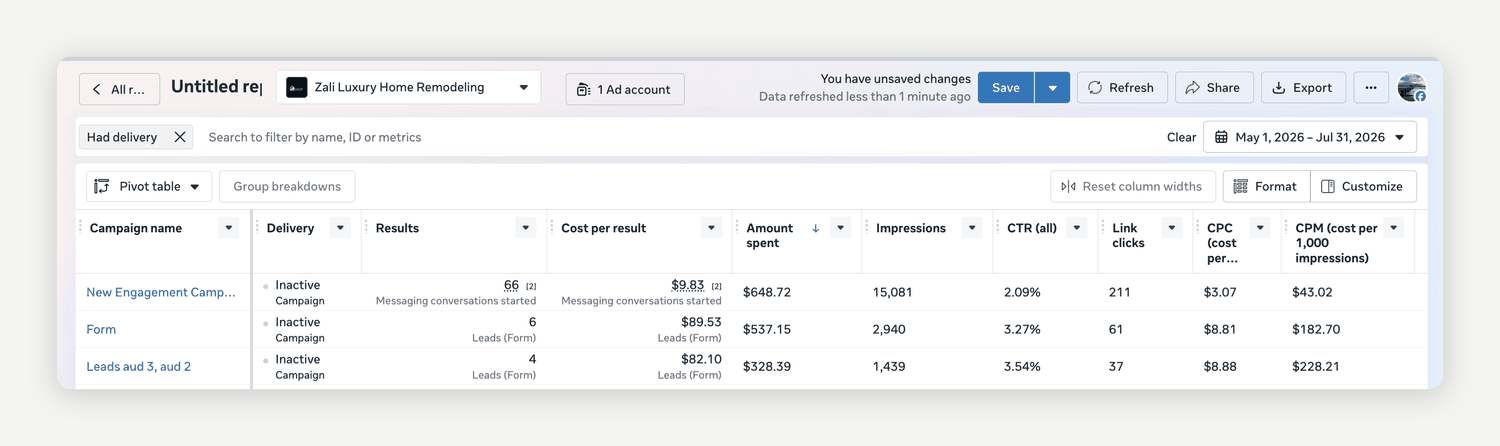
Every agency has an opinion about lead forms. We ran the question as an experiment instead, with real money on both sides, the same audiences and the same creative. Three rounds, each one answering a single question, and the answer contradicted the standard advice for home services.
| Round | What we ran | Result |
|---|---|---|
| 1. Lead forms | The standard play for home services: an instant form inside Instagram, the contact landing straight in the CRM | 13 leads at $78.55 on average |
| 2. Forms and messages in parallel | Same audiences, same creatives, two entry points running side by side. An honest test of what the customer prefers rather than what we prefer | Messages won by a wide margin |
| 3. Messages only | The full budget into messaging campaigns. The customer writes, a manager answers and qualifies the project inside the chat | 331 conversations at $12.47 |
A conversation cost 9× less than a form lead
In the same ad account, on the same audience, a direct message came in at $9.83 while a lead form cost $89.53. A homeowner weighing a $50,000 project does not want to fill in a form in their feed and wait. They want to ask one question and hear a human being. Rather than defend the format we had already paid to build, we moved the money.
Why the Gap Is So Wide
- A form asks for commitment before it gives value. A message asks a question, which costs the person nothing to answer
- A chat qualifies in real time. Scope, budget and timeline are established in the first four replies instead of in a call three days later
- Response speed decides the deal. In chat the manager answers within minutes, while a form lead sits until somebody works the list
- The conversation is already the sale. By the time an estimate is booked, the customer has been talking to the company rather than to a landing page
Account Structure and Where the Budget Went
Results in the original ad account had flattened. Costs were climbing while volume stood still, which usually means the account has learned a pattern that no longer matches the strategy. Spending harder into that would have been the expensive mistake, so we built two new accounts, picked fresh audiences and let them learn from zero. The cheapest lead of the whole project came out of that rebuild.
| Format | Leads | Cost per lead | Spend |
|---|---|---|---|
| Direct messages | 331 | $12.47 | $4,129.15 |
| Lead forms | 13 | $78.55 | $1,021.11 |
| Total | 344 | $14.97 | $5,150.26 |
How the Account Was Built
| Decision | The reasoning |
|---|---|
| One campaign per segment | Homeowners, the trade and commercial never share a budget, so that a cheap lead in one does not hide an expensive lead in another |
| Two fresh ad accounts | A clean learning phase beats fighting an account that has optimized toward the wrong signal for years |
| Optimizing on conversations | The algorithm delivers whatever you ask it to count. Asked for clicks it brings clicks, asked for conversations it brings customers |
| Creative rotated by role | Each format is replaced when it stops doing its specific job, rather than refreshing the whole account at once and losing the learning |
| Weekly review on cost per conversation | One metric that the business recognizes, broken down by segment and by creative |
A lead here is a person who wrote to the company and started a conversation about their project. Source: Meta Ads Manager, May to September 2026
What the Ads Turned Into
Cost per lead is only half an answer. A cheap lead that never books a site visit is an expensive lead with better reporting, so the campaign was judged on what reached the CRM rather than on what reached the feed.
| Stage | Result |
|---|---|
| Ad spend | $5,150 |
| Leads, people who wrote in and started a conversation | 344 |
| Opportunities, where scope, budget and timeline were discussed | 129 |
| Site visits and written estimates | 68 |
| Total value of the estimates issued | $1.02M |
| Closed and paid inside the campaign window | $45,000 |
Roughly one in five conversations became a booked site visit, which is the number that makes a $12 lead worth having. Remodeling is a slow sale, so the $45,000 is only what closed while the campaign was still running. A homeowner who asked for a price in June may sign in the following spring, and most of the $1.02M is still live in the pipeline.
Source: the client’s CRM. Opportunities and estimates from the first weeks, before every lead was being logged, are reconstructed proportionally by month
Summary
May 2026
Boosting from a phone
- Cost per lead not measured
- Audiences broad Miami
- Offers none
- Creative raw clips
- Followers 5,900
September 2026
A tested system
- Cost per lead $14.97
- Audiences 3 segments
- Offers priced and tested
- Creative 6 formats
- Followers 7,199
Four Things Any Contractor Can Take From This
- The offer decides the cost per lead, not the targeting. Naming a starting price in a market where nobody named one did more than any audience setting
- Test the entry format with real money. A conversation cost $9.83 where a lead form cost $89.53, on the same audience and the same creative, and no amount of theory would have found that
- The content is part of the ad buy. 83% of organic views came from people who do not follow the account, and that is the profile every paid click lands on
- Rebuild a stalled account instead of spending harder into it. The cheapest lead of the project came from an account that started learning from zero
What happens next
A quiz funnel and the cold traffic campaign that feeds it are built and ready to launch. The quiz keeps the low friction of a conversation while qualifying the project before a manager ever replies, so we expect warmer leads at a similar cost.
Want Results Like These From a Professional Team?
We run Meta advertising and the content behind it for home services companies in the U.S.: research, positioning, creative production, structured testing and reporting on the numbers your business actually uses.
What you get:
- Competitor research before a dollar is spent, not after
- Offers written per segment and tested against each other
- A creative library where every format has a job
- An account structure you can read, with clean learning and no guesswork
- Daily content that makes the profile worth the click you paid for
- Weekly reporting on cost per conversation, by segment and by creative
Message us or request a quote on the site, and we will look at your business and tell you how many leads it can realistically get. See how we work with remodeling companies and contractors.
Ready to speak with a marketing expert?
give us a call or text
+1 877-679-8111give us a call or text
Leading Digital Marketing Agency
90+ Websites Launched
$10M+ Client Revenue Generated